
Author: Br. Madhavamrita

  • Līlās Around Amma

    Līlās Around Amma

    Her Divine Grace

    In the past, my daughter was not particularly interested in Amma. During one of Amma’s visits to Bangalore, she managed to receive Amma’s darśan one morning, despite the exceptionally large crowd of devotees that day. Later that afternoon, my daughter surprised me by asking if she could go for darśan again. Since she had never shown any special enthusiasm for Amma before, her request took me aback.

    Seeing this as a positive sign, I arranged for another darśan token for her, even though I knew inwardly that it was not the right thing to do. I asked her to stand at the very end of the darśan line, which extended beyond the main gate. As she waited there, I silently prayed to Amma to grant my daughter a little extra time during darśan.

    After several hours, my daughter finally reached Amma. I stood nearby, watching closely. Amma held my daughter in her arms while simultaneously speaking to someone else. At that moment, I realized that Amma had answered my prayer. Filled with gratitude, I bowed to her mentally.

    The very next second, Amma picked up the microphone and announced, “There are thousands of people waiting to receive Amma’s darśan. Some have not received darśan even after waiting for eight or nine hours. My dear children, is it right to come for darśan a second time?”

    Tears of remorse welled up in my eyes. At the same time, I marvelled at Amma’s omniscience. I knew I alone was responsible. In my eagerness for my daughter to develop devotion towards Amma, I had acted selfishly. I silently apologized to Amma from the depths of my heart.

    About twenty-five years ago, my daughter once went to the bus stop to catch her school bus. When the bus arrived, instead of boarding it, she ran back home, threw her schoolbag aside, collapsed onto the bed, and began foaming at the mouth. She regained consciousness only after two days. Neighbours suggested that she might have suffered some form of epileptic seizure. I had my doubts — if it truly was a seizure, how had she managed to run home safely?

    Local doctors were unable to diagnose her condition. I took her to renowned hospitals in Bangalore and Kerala. The doctors prescribed multiple tablets to be taken morning and evening. Despite this, the episodes continued — twice a month — for over six years.

    One doctor referred us to a well-known neurologist, who ordered fresh tests and prescribed even more medication. Yet, even after six months, there was no improvement. The neurologist eventually declared the condition incurable and said my daughter would need to remain on medication for life.

    I continued praying fervently to Amma. By her grace, although the episodes persisted, they never occurred while my daughter was travelling to school or to her tuition centre, only at home.

    Swāmīs and brahmacāris who knew me urged me repeatedly to inform Amma. Many times, I resolved to tell her, but whenever I approached Amma, an inexplicable silence would overcome me.

    Once, when volunteers in Bangalore went for darśan, a devotee firmly insisted that I speak to Amma about my daughter’s condition. Yet again, when I stood before Amma, I said nothing. As I was about to leave, that devotee sternly warned me, “If you’re not going to tell Amma, then I will!”

    Hearing this, Amma turned to me and asked gently, “What’s wrong, son? What happened?” At last, I opened my heart and spoke about my daughter’s illness. Amma listened compassionately and said, “Amma will make a saṅkalpa (divine resolve), son.”

    Though more than 25 years have passed, I still vividly remember the boundless compassion on Amma’s face. Seeing that expression, I was unable to speak; I could only weep.

    After that momentous darśan, I stopped my daughter’s medication. From that day onward, she never experienced another episode. If this is not Amma’s divine grace, then what is? By Amma’s blessings, my daughter is today enjoying good health and a happy married life.

     — Damodaran, India

    Her Voice

    In early 2010, I dreamt that Amma arrived at a palm-leaf hut with her disciples. She took my hands, made me sit down, and taught me a song. The dream then ended. Unsure of its meaning, I assumed Amma had simply granted me a dream darśan and thought nothing more of it.

    A few days later, my younger sister called me and said that she had had a dream in which Amma taught me a song. Our dreams were identical. It then dawned on me that this was no ordinary dream — Amma herself had taught me how to sing. Thereafter, by Amma’s grace, I began singing bhajans.

    Years later, a devotee rebuked me sharply: “Do you think you’re great just because you sing bhajans? Has pride entered your head? Do you think we are here to serve your singing? One should serve only those in need — that is karma yōga.”

    I remained silent, but inwardly I was deeply hurt and angry with that devotee. When I returned home, I stood before Amma’s photograph and prayed: “Amma, I am deeply hurt. What do I know? You are the one who made me sing. Therefore, whether I receive praise or blame for my singing, it all belongs to you alone. Please take my pain as well.”

    Although the hurt lingered and the anger continued to simmer, I restrained myself for Amma’s sake.

    Soon afterward, the same devotee approached me and said, “I dreamt of you. In that dream, you were leaning against a pillar and singing, yet your mouth wasn’t moving. I asked you, ‘How are you singing when your mouth isn’t moving?’ You replied, ‘Look inside!’ We were standing in a temple. When I looked inside, I saw Goddess Kālī singing. All along, Kālī alone had been singing through your voice.”

    I was stunned. I returned home in a state of awe and bliss. Kneeling before the altar of Amma, I thanked her. From this incident, I realized that my voice is not mine — it belongs to Kālī. Not just my voice, but all voices are Hers — Amma’s. I also understood that on the path of devotion, patience is essential. Once we surrender a problem to Amma, we must wait patiently for her to resolve it in her own way.

    Yet, despite these lessons, I faltered again. Once, while alone in the local āśram, I began singing bhajans in various pitches using a śruti box, an instrument that provides a continuous drone to help maintain pitch. After some time, a thought crept in: “Aha! How talented I am! How else could I sing so skilfully in different pitches?”

    The very moment this thought arose, the śruti box suddenly stopped working. No matter how many times I tried, it would not start.

    Realizing my folly, I prayed contritely to Amma. I saw clearly that I had been singing not with devotion, but with ego. Prostrating before Amma’s photograph, I prayed with tears: “Amma, this voice is yours, yet I foolishly claim it as mine. Please forgive me.”

    With deep feeling, I began chanting:

    twamēva mātā ca pitā twamēva

    twamēva bandhuśca sakhā twamēva

    twamēva vidyā draviṇam twamēva

    twamēva sarvam amṛtēśvarī mā

    You are my mother and my father,

    You are my relative and my friend.

    You are my knowledge and my wealth,

    You are my everything, O Mother Amṛtēśwarī.

    As I sang, the śruti box began to function again. The pitch it produced perfectly matched the pitch of my voice.

     — Ramachandran Murugayah, Malaysia

    Magic of Divine Love

    During Amma’s 2025 Europe Tour, I invited a friend — who lives about three hours away from the Hof Herrenberg āśram in Germany — to visit me at the āśram. I had spoken to her about Amma a few years earlier, and she agreed to come.

    Whenever my friends are about to meet Amma for the first time, I find myself becoming more excited than they are. I began imagining how this meeting would transform my friend’s life and how she would soon become Amma’s devotee.

    However, a day before the program, she sent me a message:

    I don’t really care about Amma’s program. I’m not a big fan of her hugs, especially since I’d have to queue for a long time to get darśan. Maybe I’ll skip it. I just want to see you and have a fun, relaxing weekend.

    I felt disappointed and lost all interest in meeting her. I began judging her, labelling her as a worldly person who knew nothing about spirituality.

    After I calmed down, I asked myself what Amma would do if she were in my place. If I truly wished to introduce my friends to Amma, the most important thing was not to judge them. Between my friends and Amma, there is a bridge — me. If I am impatient and judgmental, it is as though that bridge is already broken.

    I remembered that I, too, had once been a worldly person, with no interest at all in spiritual liberation. Yet Amma has been infinitely patient with me. She never gave up on me. That is why I am close to her today.

    So, I decided to practise patience. I messaged my friend: “Don’t worry. I’ll take care of you when you get here.”

    She was travelling with her one-year-old daughter and had many concerns: Would she be able to get a darśan token? How long would she have to wait in line? Would she need to stay overnight? Would her baby be able to rest during the program?

    I reassured her, saying, “I’ll be your babysitter for three days. I’ll queue up and get the tokens for you and your daughter. You can both rest during that time.”

    When my friend arrived, I stayed by her side for the entire three days. She had never met a spiritual master before. Although she seemed respectful towards Amma, I sensed that she did not truly believe in Amma’s divinity. Still, Amma’s grace flowed to her effortlessly.

    On the first day of the program, just as Amma entered the hall, my friend’s daughter suddenly stood up in her mother’s arms and began clapping and jumping with joy. My friend was stunned — her daughter had never behaved like this before. In fact, she was usually nervous around people.

    As Amma walked in, the baby began laughing. Then, for the first time ever, she leaned forward and kissed her mother on the lips.

    The look of disbelief on my friend’s face said everything. Tears welled up in her eyes. Soon after, her daughter began playing joyfully on the floor, light and carefree, like a butterfly. It was hard to believe that this was the same shy, introverted toddler. Over the next three days, she made many friends at the venue.

    After witnessing this, my friend began looking forward to her first darśan and insisted that I accompany her. As Amma was about to hug her, the bhajan group sang:

    In the still of the night,

    From the darkness comes a light.

    Then I know from my heart,

    It is you… it is you… it is you!

    I burst into tears. “Yes, it is you, Amma,” my heart whispered. “Thank you for loving my friend. You are our only hope on the spiritual path. Please help us all.”

    The friend who had earlier said that she had no interest in Amma’s hug now wanted darśan again. On the second day, we woke up at 6 a.m. and reached the hall by 7:30 a.m. to join the darśan line. Before the program, my friend had made me promise her that I would not ask her to wake up early. On the third day, she said, “I want a mantra from Amma.”

    Her love for Amma grew day by day. It was astonishing to see someone who had never met Amma before transform so deeply in such a short time.

    Through this experience, I realized once again how essential patience is. It is only because Amma is endlessly patient with all of us that we are able to change. Day after day, month after month, year after year, she remains available — singing and meditating with us and repeating her teachings again and again. Amma has said it so beautifully: the Guru’s patience is what redeems the disciple.

    I learned yet again that the power of Amma’s love and presence cannot be explained. We do not need to worry about turning anyone into Amma’s devotee. She has her own way of reaching hearts and showering divine love.  — Gita (Wang Yixuan), China
  • Self-confidence, by Sribhavani (Alida Bartesch), Germany

    Self-confidence, by Sribhavani (Alida Bartesch), Germany

    Once, when someone made critical remarks about those who follow contemporary fashion trends, Amma gently intervened:

    Don’t judge them. Through fashion, these people gain self-confidence. Everyone needs self-confidence to move forward. Seekers have spiritual knowledge that empowers them, but not everyone has that. So don’t judge them.

    I was struck by the vast understanding and compassion behind Amma’s words. From a worldly perspective, self-confidence is usually defined as trust in one’s own abilities, qualities and judgments. Such confidence often arises from the feeling: “I have achieved something. I possess wealth, status or recognition. I have done something remarkable. I am special.”

    But because these supports are temporary, this kind of confidence is also temporary. Even so, it is important. Without confidence, even small tasks can feel impossible. We procrastinate, avoid or hide, not because we are incapable, but because we do not trust ourselves enough to act.

    When Amma said that seekers are fortunate to possess spiritual knowledge, which is empowering, I understood her to mean that we must use our capacities and talents with the clear awareness that the true power behind all action comes from God — from the Self alone. This is genuine Self-confidence. Such understanding shifts the focus away from personal ability to divine grace. The confidence that arises from this shift is not fleeting, because it is rooted in the eternal.

    For much of my life, I lacked self-confidence. In first grade, I was publicly humiliated before my entire school — more than 400 students. The experience was devastating and shattered my confidence. I silently vowed to avoid public exposure, and I became quite successful in keeping that vow. By repeatedly limiting myself, I only strengthened my diffidence.

    During the coronavirus lockdown, Amma not only asked us to give satsaṅgs but also began posing questions. I loved reflecting on them, yet I never intended to speak publicly, even though I had answers. Amma, however, encouraged me to speak — forcing me to confront the deep-seated lack of confidence I had carried since childhood. She gave me detailed guidance on how to proceed, how to prepare, and what to keep in mind. Eventually, I felt I had no choice but to stand up and expose myself publicly.

    Fear and anxiety overwhelmed me, and I could not prepare well. When I began speaking, I became acutely aware of my shortcomings even as the words left my mouth. After a few minutes, Amma smiled lovingly and gestured for me to sit down before I had finished.

    On one level, I accepted Amma’s wish. On another, I felt I had failed. I concluded that public exposure simply was not for me.

    Yet Amma continued to encourage me. I cannot adequately describe the struggle and pain I went through during that period. Through the classes I attended and Amma’s teachings, I gradually gained clarity, shed mistaken notions, and learned to follow her guidance.

    What ultimately helped me move forward was not confidence in my abilities, but a firm conviction that I must do whatever Amma asked of me — because it was for my highest good, regardless of how I felt.

    When I stood up to speak a second time, uneasiness returned. The old childhood pain resurfaced, and whatever little confidence I had vanished. I wanted to flee. My legs trembled, my throat was dry, and I felt I might faint. The camera was focused on me. Thousands of eyes were watching. All I could do was pray to Amma: “This is your wish. Please guide me and give me the strength to accept whatever happens.”

    Fixing my attention on Amma, I read the answer I had prepared. When I finished, Amma took the microphone and spoke. She gave very positive feedback and emphasized that even if we fail the first time, we can still progress if we persevere.

    What changed was not the external situation, but where I placed my trust. I shifted my confidence from my own abilities to Amma. Left to myself, I would never have found the courage even to attempt public exposure. It was only Amma’s loving guidance and my firm conviction that she creates circumstances solely for my good that helped me overcome a lifelong limitation I had imposed upon myself.

    In doing so, I learned to become my own friend rather than my own enemy. As Śrī Kṛṣṇa says:

    uddharēd ātmanātmānam nātmānam avasādayet

    ātmaiva hyātmano bandhur ātmaiva ripur ātmanaḥ

    Uplift yourself by your own effort; do not degrade yourself.

    The Self alone is your friend — and your enemy. (Bhagavad Gītā, 6.5)

    Worldly self-confidence, based on abilities and achievements, may support us but it remains fragile. Confidence in Amma offers a far deeper strength. It reassures us that we are never alone and that we are acceptable just as we are — as children of the Divine Mother. This nurtures a deeper trust and a lasting confidence.

    Confidence in Amma — our true Self — takes us even further. It helps us recognize who we truly are and supports us in overcoming our vāsanās (latent tendencies). Amma is the embodiment of the Self. As we gradually understand and assimilate this truth through her boundless grace, trust in the Self deepens, until only the Self remains.From that Self arise true understanding and compassion — the very qualities Amma expressed in her response to the comments on fashion. May we all grow in this true Self-confidence, until we dissolve in oneness with that Self.

  • Chottanikara, by Anita Raghavan, Australia

    Chottanikara, by Anita Raghavan, Australia

    Before the advent of scientific research, many cultures attributed mental disorders to supernatural causes, often believing that the afflicted were possessed by malevolent spirits. Exorcism was commonly practised as a means of healing those thought to be possessed.

    These superstitions were prevalent in Kerala as well. However, owing to the region’s strong tradition of devotion, people often sought divine help for relief from mental afflictions. At the Chottanikara Temple in Ernakulam, devotees worship Dēvī, the Goddess, with deep faith, believing that surrendering their problems to Her can alleviate all mental suffering.

    In a broader sense, we are all ‘crazy’ to some degree, caught up in the illusory world of fleeting pleasures, even though the scriptures affirm that the only true reality is God. This type of madness can only be overcome by understanding our true nature. One way to achieve this is through devotion to the Divine Mother, who manifests in the form of Amma, our Guru.

    Amma says, “Strange are the ways of a mahātmā (spiritually illumined soul). The human intellect cannot comprehend great souls and, therefore, may call them crazy. Their apparent craziness serves a purpose: to awaken humans to their own attachments to name, fame and wealth. Only when humans recognize their madness can it be transcended.”

    The following legend illustrates how a devotee was freed from the influence of a yakṣi (demonic spirit) through the grace of the Divine Mother. Such spirits were said to roam forests, possibly as cautionary tales to deter people from travelling in dense woods at night — much of ancient Kerala was forested.

    Guptan Nanpūtiri lived with his wife and children near the Chottanikara Temple. His Guru was Kōśappaḷḷi Ācchan Nanpūtiri. Guptan had been studying the Dēvī Bhāgavatam, a Purāṇic text venerating Dēvī as the Supreme, under his Guru’s guidance. Despite his devotion and diligent study, Guptan could not resist beautiful women.

    One day, Guptan set out to attend a Kathakaḷi dance performance nine kilometres away, intending to return the Dēvī Bhāgavatam to his Guru, whose house was near the performance venue. Clutching the sacred text, he traversed the rugged forest. Pausing to rest on a boulder, he suddenly heard the soft tinkling of anklets. A strikingly beautiful woman appeared before him, introducing herself as Ittarattu Vāryasyar. She claimed to be travelling to the same performance and, expressing her gratitude at finding Guptan, asked if they could walk together. Unable to resist her charm, he agreed.

    As they journeyed, she inquired about the book he carried. Guptan explained it was the Dēvī Bhāgavatam. Guptan became increasingly captivated by Ittarattu. He tried to put his arm around her but she dodged him with a laugh. Smiling sweetly, she asked him to put the book aside to fully embrace her, but out of deference to the sacred text, he respectfully refused. Upon reaching his Guru’s house, he asked her to wait outside, feeling it inappropriate to enter with a woman. She protested, but he assured her he would return quickly.

    Kōśappaḷḷi noticed Guptan’s anxious demeanour. Suspecting something amiss, he had Guptan hold his arm and look outside. To Guptan’s horror, the beautiful woman had transformed into a fearsome yakṣi, with bloodshot eyes and protruding teeth. Trembling, Guptan clutched his Guru’s feet, begging for help.

    Kōśappaḷḷi gave Guptan a wet cloth, chanting mantras into it, and instructed him to run to the Chottanikara Temple. Upon entering, he was to throw the cloth behind him over his head. Guptan ran, the yakṣi in pursuit. He reached the temple first, placed a foot over the threshold, and threw the cloth. But the yakṣi grabbed his other foot. He fell and prayed to the Divine Mother.

    Moved by his devotion, Dēvī appeared, sword in hand, and pursued the yakṣi. Dēvī seized the yakṣi by the hair, beheaded her, and threw the head into the southern temple tank, now called Raktakuḷam (‘blood tank’). Grateful, Guptan performed abhiṣēka (ceremonial bath) to Dēvī and offered puffed rice to her — a practice that continues to this day. Transformed by this experience, Guptan overcame his weaknesses and dedicated his heart wholly to God.

    Mental instability can also arise from external events that upset the mind terribly. According to the sthala-purāṇa (sacred legend) of the Chottanikara Temple, the temple was consecrated by a former dacoit named Kaṇṇappan, who terrorized the local population.

    One day, he stole a calf. Intent on killing it, he brought it to his house, tied it to a tree, and went inside to fetch his axe. When he came out, he saw his young daughter caressing the calf. She begged him to let her keep the calf as her pet. Kaṇṇappan was moved by his daughter’s innocent plea and he agreed.

    A few days after this incident, that little girl suddenly passed away. Kaṇṇappan was inconsolable. His grief was so intense that he fainted. The Divine Mother appeared in his dream and revealed that She had manifested as the calf to bring about a change in him. She told him to reform his ways by installing an idol of Her in that very place and to worship Her for the rest of his life.

    Kaṇṇappan realized that the loss of his daughter was kārmic atonement for all his sinful actions. Channelling his grief into daily worship, Kaṇṇappan mended his ways and became instrumental in building the temple.

    The temple, named Jyōtiannakkara (“one who enlightens”), later became Chottanikara. It flourished as a place of solace, where devotees still seek relief from mental afflictions through the grace of Ādi Parāśakti, the Supreme Mother. Rites of exorcism continue to be performed daily, and countless accounts speak of permanent healing through Her grace.From these stories, we learn that the ultimate remedy for all afflictions — mental or spiritual — is surrender to Amma. May she remove our troubles and guide us towards enduring peace.

  • Always With Us, by Ambujam (Lakshmi Keyes), U.S.A.

    Always With Us, by Ambujam (Lakshmi Keyes), U.S.A.

    In 2003, I returned to India for the second time since childhood to attend Amritavarsham50, Amma’s fiftieth birthday celebration — a huge, four-day event held in Kochi, Kerala. One of its most moving moments was a peace procession representing 193 nations, with participants carrying their country’s flag and sacred river water. I was thrilled when the organizers asked me to walk for Honduras and carry its water, which Amma would later pour together with the waters of all nations to bless the Banyan Tree of Peace.

    As a teenager in the United States, I had marched in peace protests calling for American withdrawal from El Salvador and Honduras. Now I was walking once again for Honduras — but this time for an entirely different cause: prayers for world peace.

    As we walked, onlookers would glance at me and call out, “Hungry! Hungry!” I was initially confused, until I realized they were reading the name of the country printed behind me — Hungary. Yet hearing the word “hungry” repeated again and again pierced my heart. It felt as though they were voicing the unspoken hunger of people across the world. In that moment, I caught a faint glimpse of what Amma hears — and responds to — unceasingly.

    Amma teaches that there are two kinds of poverty: the poverty of food and basic needs, and the poverty of love. Perhaps this is why her charitable work has always moved me so deeply. As a child, I experienced both forms of hunger — material deprivation from an austere upbringing that sometimes used food denial as punishment, and an even deeper hunger for motherly love. A few months after Amritavarsham50, Amma invited me to the āśram to join her mission of love and compassion through selfless service.

    Though I remain profoundly grateful for this calling, a life of sacrifice and service has not been easy for me. The COVID period was especially challenging — marked by sāḍhē sātī (an astrological phase of intense trials), prolonged quarantines, the collapse of my sēvā, clashes with authority, and the loss of physical proximity to Amma. Amma had always been my all in all, and being separated from her devastated me. Even after 20 years as a renunciate, I felt unable to surrender fully. Deprived of direct guidance, I fell into deep despair.

    During this time, I dreamt that my room had been burgled and I was crying uncontrollably. In the dream, Amma came, held me, and said, “It’s good for you to feel what many people in India are experiencing.”

    Soon afterward, we were asked to vacate our rooms so they could be used as quarantine facilities. What initially felt like yet another loss gradually became a gift. These sorrows — especially the pain of physical separation from Amma — pushed me to paint again for the first time since youth and to reconnect with Amma and the Divine through art.

    Later, when I was given the opportunity to photograph women during the Amrita-SREE sārī and prasād kit distribution tour, I bonded deeply with them. Remembering Amma’s words from my dream, I realized that these small disruptions to my own comfort were enabling me to relate more authentically to women who had so little. The photographs I took were screened in the āśram auditorium for many years.

    When I learned that I might travel with Amma to Faridabad for the inauguration of the hospital there, I eagerly anticipated being near her again, serving behind her chair during tea stops. Before we left Faridabad, serious health issues arose, and my doctor advised against travel. Feeling hopeless and disconnected, I began to believe that āśram life was no longer meant for me.

    I asked Amma for permission to return to the West to seek help for menopause. She agreed. Under my breath, I said to her, “If you want me to come back, you will have to call me.” I knew she heard me.

    Because my passport was in Amṛtapuri, I had to wait a week until a brahmacāri travelling for sēvā could bring it to Faridabad. He suggested I take the taxi arranged to pick him up from the airport.

    Amma often explains that cars symbolize mamakār (the sense of ‘mine’), ahaṅkār (the sense of ‘I’) and ōmkār(the sense of the Divine). The taxi driver’s name was Ōmkār. I took it as a good sign.

    On the way, Ōmkār picked up a friend. This made me uneasy, though I felt unable to protest. Three-quarters of the way to the airport, the driver stopped at a bus stop and ordered me out. I refused and called the taxi manager, explaining that I was frightened to be left there. Despite this, the driver insisted. I got out, and he drove off before I could retrieve my luggage.

    I stood alone at the bus stop for a long time — the only woman there. Some men nearby looked intoxicated, possibly using drugs. One of them began harassing me. I shouted, “Go! Go!” but he wouldn’t leave. I kept calling the car service. Each promised arrival — five minutes — stretch-ed into nearly an hour. Meanwhile, the brahmacāri who had my passport had already landed and was anxiously calling.

    Then a bus arrived, and a woman stepped off with a small boy, no more than two years old. I felt immense relief. The child looked like baby Kṛṣṇa to me. He smiled at me, then made a comically embarrassed face as his mother checked his diaper. I laughed — and he laughed back.

    Seeing us, the woman smiled and asked, “Amṛtānandamayī?” How did she know? I was alone, at a random bus stop in Delhi, wearing only a white salwār kamīz.

    “Yes,” I replied, astonished.

    She then said, “Ōm amṛtēśwaryai namaḥ,” with such force that it felt like Amma herself was reminding me to chant my mantra. Minutes later, another bus arrived, and the woman left with her child.

    Earlier that morning, I had found a one-legged cricket in my room and had chanted the same mantra for it, praying for its survival or a better rebirth. The way this woman uttered the mantra reminded me of how I pray for helpless creatures. Perhaps, in that moment, I was the creature in need of grace.

    Eventually, the taxi returned. I got in; my bags were still there. The driver and his friend were intoxicated. The driver kept falling asleep and the car kept swerving. I shouted and clapped my hands in front of his face to keep him awake. Time and again, other vehicles veered away from us at the last moment. That we survived the entire drive was nothing but grace.

    At the airport, the driver stopped in the middle of the road and got out. The police ordered us to move. I then realized we were at the wrong airport. The only option was for me to drive. Though I had never driven in India and was terrified, I knew at least my eyes were open.

    I took the keys, made the men sit in the back with seatbelts on, and faced one of my greatest fears — driving in a foreign country, on the opposite side of the road, with the gear shift on the left. My left hand barely knew what to do. Yet somehow, the car moved. I knew Amma was driving; I was merely her instrument.

    I discreetly filmed the men as proof of their intoxication, since the taxi manager had not believed me. When we reached the correct airport, I handed the car — and the men — over to the brahmacāri. I felt compassion for the intoxicated men; they were young and destroying their lives.

    On the flight, I had a nightmare similar to those from my childhood — men trying to abduct and violate me. I was pinned down, unable to escape. I awoke suddenly, freezing cold, and realized that Amma had not only saved my life that day but had also shielded me from a fate that had haunted me since childhood.

    Shivering, I put my hands into the pockets of my jacket — one I had not worn in over a year — and felt something inside. It was Amma’s prasād candy, the one piece remaining after I had shared the others with homeless people in New York. The blessing I had given had returned to me. I felt profoundly grateful.

    It was Ōṇam a few days later. I missed Amma deeply. That night, I researched ways to make taxis safer for women. I thought of proposing women-driven taxis to Amma.

    Just then, I received a call: “Amma is talking about you.” She was recounting the taxi incident, praising my courage and asking young women if they could have done the same. Everyone was laughing — including Amma. At first, I was startled. The experience had been terrifying. Why was she laughing?

    Then I understood. Amma was celebrating my victory — not the trauma. She was teaching me to focus on overcoming obstacles and not dwell on them. When Arjuna surrendered to Kṛṣṇa, he did not collapse — he rose to fight. As the Bhagavad Gītā says:

    uddharēd ātmanātmānam nātmānam avasādayēt

    ātmaiva hyātmanō bandhuḥ ātmaiva ripur ātmanaḥ

    Uplift yourself by your own effort; do not degrade yourself. The Self alone is your friend — and your enemy. (6.5)

    Though Amma worked through me that day, she gave me the credit. I felt like a zero, yet she made me a hero. From the way she said, “Ambujam got herself to the airport,” I understood her message: surrender is not passive resignation, but courageous action, one that is aligned with divine will.

    This encouragement empowered me to return to the āśram and continue striving.

    Recently, a renowned Vēdic astrologer told me that the sāḍhē sātī I endured was so severe that had I not been with Amma, I would not have survived. By her grace alone, I did — so that I may continue striving to fulfil the purpose of this birth.

    Last April, while I was editing photographs, Amma called me and introduced me to tribal women from Wayanad who produce lemongrass essential oil using a solar-powered distiller provided by Amrita University. Though their oil was of world-class quality, they did not know how to sell it. Amma said simply, “They are hungry. Please help.”

    The same word that had once pierced my heart — “Hungry” — returned through Amma’s lips. Through this project, she is addressing both the women’s hunger for sustenance and our own hunger for healing and motherly nourishment.

    When I had COVID, I lost my sense of smell. Today, even birds and bees are losing their way home due to pollution and chemical interference. Amma is giving us tools to regain our senses and find our way back.

    Smell is unique — it travels directly to the brain. Something pure can bring us back to our centre. Lemongrass oil refreshes body, mind and spirit, easing fatigue, tension and nausea. Its exceptional purity creates an immediate reset, reminding us of the healing, infinite love of Mother Nature — our source.Amma is always giving us exactly what we need. She is always with us.

  • True Love, by Br. Jayadēva Caitanya

    True Love, by Br. Jayadēva Caitanya

    Although the sun is immeasurably distant, its rays reach the lotuses on earth and cause them to blossom. In the same way, Amma says that where there is true love, distance is of no consequence. There is hardly a day when Amma does not speak of divine love.

    Saint Tirumūlar sings:

    The ignorant prate that Love and Śiva are two;

    None realize that Love alone is Śiva.

    When one knows that Love and Śiva are the same,

    Love itself abides eternally as Śiva. (Tirumandiram, 270)

    Divine love is grace, and Śiva is bliss. They are like a bell and its sound — one cannot exist without the other.

    Sanātana Dharma has identified several paths to God, including jñāna yōga (the path of wisdom), bhakti yōga(the path of devotion) and karma yōga (the path of selfless action). Among these, the path of devotion is often regarded as the easiest. Yet devotion is of different grades. There is kamsa-bhakti, devotion born of fear; kāmya-bhakti, devotion motivated by the fulfilment of desires; and prēma-bhakti, love for love’s sake. The last alone is pure devotion — love that seeks nothing but God.

    True love is innate. Once we tap into this inner wellspring, we experience the same love for everyone, regardless of outer form. Honey tastes equally sweet, no matter the vessel that holds it. Love alone is truth. In pure love, there is no ‘two;’ all distance dissolves in divine love.

    Amma often says that worldly love — such as the love between husband and wife — is like the love between two beggars: both are needy. Such love is often merely a mask worn to gratify one’s own needs. When expectations are not met, the so-called love fractures. We see this frequently in worldly relationships, where “I can’t live without you for even a second!” quickly degenerates into “I can’t live with you for even a second!”

    Worldly love may be sweet at first, but it often turns sour with time. Devotion to God, on the other hand, may present challenges initially, yet its end is bliss. True love flowers only when we realize our true nature through sacrifice, discipline and inner purification.

    Generally, those who attain the heights of spiritual bliss tend to withdraw from society, preferring to dwell in unbroken inner joy. Amma is not like that. The very embodiment of compassion, she seeks to uplift all beings to the summit of bliss. She travels tirelessly across the world to serve humanity, making no distinctions of religion, gender, caste, or social status. In this way, Amma has transcended the barriers of distance, nation and language, winning hearts through her universal love. By alleviating suffering, she has bestowed peace upon millions.

    Amma has also set a living example in protecting and nurturing nature. One such instance is the massive cleaning effort at Śabarimala. Under her guidance, tons of waste were cleared from the sacred hills, which had not been cleaned for many years. Many of us were blessed to participate in this endeavour, inspired purely by our love for Amma. Thus, the effort benefited not only nature but also brought deep joy and fulfilment to countless hearts.

    Amma’s love for nature is truly awe-inspiring. Once, a brahmacāri who wished to receive Amma’s blessings before delivering a talk plucked a flower and offered it to her. Amma noticed a tiny bud still attached to the flower and gently admonished him, saying, “You took the life of the bud.” Not only does Amma perceive the Supreme Consciousness in everything — even in a tender flower bud — but her boundless motherly love cannot tolerate harm to any part of her creation.

    The poet-saint, mystic and reformer Rāmaliṅga Vaḷḷalār taught that compassion towards all living beings is not only the foremost prerequisite for realizing God, but also a means of neutralizing past negative karmas. Echoing this truth, Amma constantly reminds us that “a smiling face, gentle words, and compassion to others” are themselves expressions of love for God.

    Because she perceives divinity in all, Amma addresses us as “embodiments of pure love and the supreme self.” Her love is not worldly love; it is love of and for the Self. One of the mantras in Amma’s Aṣṭōttaram (108 divine attributes) proclaims:

    ōm prēmabhakti-sudhā-sikta-sādhu-citta-guhājuṣe namaḥ

    Salutations to Amma, who dwells in the cave of the pure hearts drenched in the nectar of devotion. (78)

    Where there is pure love, there Amma resides. Amma says, “A candle burns itself to give light to others. Likewise, we must live lives of self-sacrifice, and there must be love in that sacrifice. Only then will our lives become truly fragrant.”

    When a seed grows into a sapling, the seed loses its separate existence. When a flower becomes a fruit, the flower ceases to be. In the same way, love for God dissolves selfishness and unites us with Him. Such devotion is true bhakti. Bhakti assumes different names according to its nature. Hanumān’s devotion to Śrī Rāma was that of a servant to his master and is known as dāsya bhakti. Arjuna’s devotion to Śrī Kṛṣṇa was that of intimate friendship, called sakhya bhakti. Yaśōdā’s love for Śrī Kṛṣṇa was imbued with maternal affection and is known as vātsalya bhakti. The devotion of the individual soul (jīvātman) towards the supreme soul (paramātman) is called mādhurya bhakti — such was Rādhā’s love for Lord Kṛṣṇa.

    The nectar of divine love is incomprehensible to the worldly mind. One who tastes it becomes one with God — one with Love itself. The devotee and God are not two, but expressions of the same divine consciousness (caitanya).

    If we have not experienced true love, we may mistake worldly love for it. Yet there are clear distinctions between the two:

    1. Worldly love is selfish, whereas true love is selfless.
    2. Worldly love is centred on the body, whereas true love is rooted in pure consciousness.
    3. Worldly love often leads to sorrow, while true love abounds in peace and bliss.
    4. In worldly love, one becomes attached to the object of love; in true love, God becomes bound to the devotee.
    5. Worldly love soon loses its lustre, whereas the bliss of true love continues to grow.
    6. Worldly love is marked by duality and separation, whereas in true love, the devotee and the Beloved become one.

    In true love, there is no sense of ‘I.’ Divine love arises from the heart — not from the mind or the intellect.

    I am reminded of the story of Kaṇṇappa Nāyanār, an uneducated hunter whose love for Lord Śiva was pure and absolute, though he knew nothing of the formal protocols of worship. Once, he collected water in his mouth and used it to perform abhiṣēka (ceremonial bathing) for a Śivaliṅga. He even placed his foot upon the liṅga, having no sense that God was separate from himself. He had realized the truth of the great Upaniṣadic declaration, “You are That,” and thus merged into the Supreme.

    In jñāna and karma yōgas, the responsibility lies with us to hold on to God — much like a baby monkey clings tightly to its mother as she leaps from branch to branch. In bhakti yōga, however, God holds firmly to the devotee, just as a mother cat carries her kitten. In this path of devotion, the devotee feels no burden.

    We do not know when or how the Guru will shower her grace upon us. Before 2001, I had asked Amma four or five times whether I could join the āśram. Each time, she would respond, “Āśram life is difficult,” or simply, “Not now.” Once, I came to Amṛtapuri with only one change of clothes, assuming that Amma would not permit me to stay and that I would return after a day or two. When I went for darśan, I felt inspired to ask Amma once again if I could remain in the āśram. To my surprise, Amma agreed immediately. I was overjoyed, yet also hesitant, as I was then working for a company and running two businesses of my own. I wondered, “Should I stay now or return later? If I leave now, will I be allowed to come back?” In the end, I decided to stay. After six months, I sought Amma’s permission to settle my worldly affairs.

    We should always follow the Guru’s instructions; otherwise, we may suffer unnecessarily. Let me share an experience to illustrate this truth. Many years ago, my sēvā was in the vehicle department of AIMS Hospital. I was asked to inspect the vehicles at the Amrita Vidyalayam in Pune. I was told clearly that Amma wanted brahmacāris to travel by train. However, on the day of departure, I learnt that an āśram truck was heading to Pune, and I chose to travel by truck instead.

    We departed at 11 p.m. There were five of us in the cabin, including the driver. Two people could lie down to sleep. I chose to sit beside the driver and keep him company. By the time we reached Thrissur, I began to feel drowsy and drifted off. It was raining heavily. At around 2 a.m., the driver lost control of the vehicle, and the truck veered off the road and plunged headlong into a 20-foot ditch. The front portion of the truck, including the cabin, was submerged in water. Miraculously, none of us were injured, nor did we feel any fear. It was as though an invisible shield had completely protected us. Yet I also realized that had I followed Amma’s instruction and travelled by train, I could have avoided the accident.

    We are where the mind is. Even being physically close to Amma will not benefit us if our thoughts are elsewhere. But when we are truly attuned to Amma, we lose all awareness of time. In true love, there is neither distance nor time.

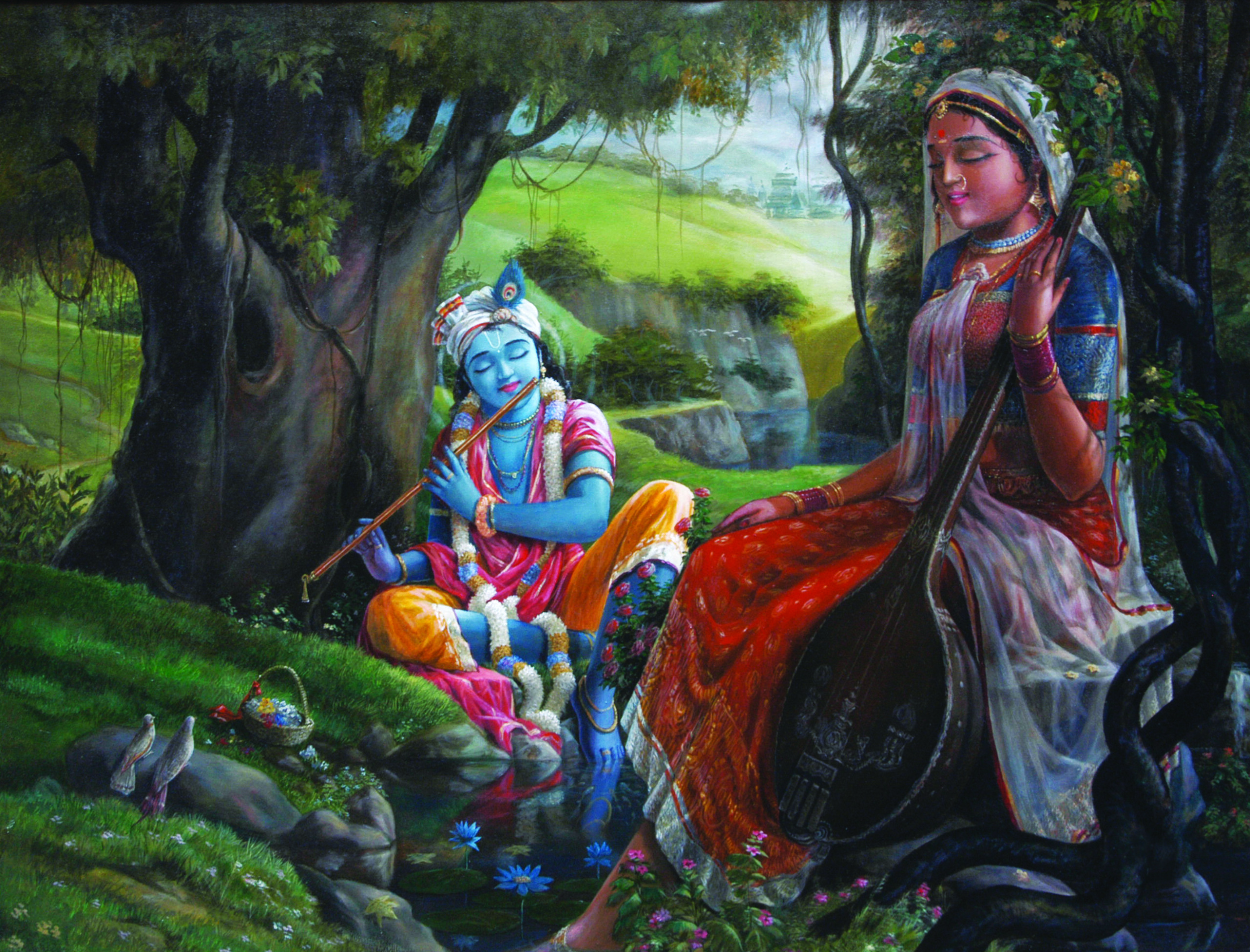
    The lives of the gōpīs (milkmaids) of Vṛndāvan beautifully exemplify this truth. Their devotion to Lord Kṛṣṇa flowed unceasingly, like a river. When the Lord played his flute, the gōpīs forgot themselves and became absorbed in the divine music. Their hearts overflowed with love for Kṛṣṇa, and fear vanished completely. Drawn irresistibly towards the source of that music, they ran to him. Some left their husbands, others their children, some their household duties, and others their adornments. Regardless of what they were doing, they abandoned it all to join their Beloved, moved solely by pure devotion.

    To illustrate how any action can be spiritualized, Amma often refers to the example of the gōpīs. They renamed the dairy products they sold — milk, yogurt and ghee — as Kṛṣṇa, Mukunda and Murāri. Likewise, they renamed cooking ingredients such as pepper and coriander as Gōvinda and Mādhava. In this way, whatever they did, they remembered Lord Kṛṣṇa constantly.

    When Kṛṣṇa finally left Vṛndāvan for Mathura, the gōpīs were overwhelmed with sorrow. They gathered together, sang his glories, and reminisced about the moments they had shared with him. Unable to bear the pain of separation, they wept aloud, their hearts steeped in longing for their Beloved.

    Kṛṣṇa came to each of them, adorned in golden robes, wearing a floral garland, and bearing a gentle smile. With the inner eye, they beheld their Lord and, recalling his līlās (divine play), revelled in supreme bliss. The devout gōpīs received Kṛṣṇa within their minds and enthroned him upon the pedestal of their hearts. Thus, they found solace from the agony of separation. Free from ego, having enshrined the Lord within, the simple gōpīs — who knew nothing of formal meditation — attained a spiritual state even higher than that of accomplished yōgīs. Though Lord Kṛṣṇa was physically far away, distance posed no barrier to their communion with him. In every thought and every action, they beheld their Beloved.

    When Uddhava arrived in Vṛndāvan carrying a message from Lord Kṛṣṇa for the gōpīs, he was astonished to discover that, through their pure love, the gōpīs had risen to a spiritual height surpassing even that of the great ṛṣis (seers). The one who had come to pass them a message instead sought their blessings.

    Saint Tiruvaḷḷuvar declares:

    The loveless belong to themselves alone;

    The loving are others’, even to the bone. (Tirukkuraḷ, 72)

    Those devoid of true love live as though everything belongs to them. Those endowed with true love consider even their bodies to belong to others and serve the world wholeheartedly.

    Amma gives of herself — and of all that she has — for the welfare of the world. It is her pure love that inspires and sustains the vast selfless service activities she undertakes. Through this love, she helps us grow spiritually and cultivate a spirit of service. At times, Amma may point out our shortcomings. When received with acceptance, such correction does not cause pain but becomes a blessing.

    There is a moving episode from the Rāmāyaṇa that illustrates divine compassion. Once, when Lord Rāma and Lakṣmaṇa went to bathe in the River Pampā, they left their bows and arrows on the riverbank. When Śrī Rāma returned after bathing and lifted his bow, he noticed blood on its tip. Tracing the blood, he found a frog lying unconscious. The Lord’s heart melted, and tears flowed from his eyes. Realizing that he had unknowingly injured the frog while placing his bow down, Lord Rāma gently lifted it, caressed it, and sprinkled water upon it. The frog soon regained consciousness.

    The Lord said, “Because I did not notice you, I caused you great pain when I placed my bow down. Why did you not cry out? Had you done so, I would have removed it at once. You cry when a snake attacks you — why not now?”

    The frog replied, “O Lord, it is true that I cry out even when pricked by a small stick. But you are God incarnate, and your sacred bow is used to destroy adharma and restore dharma. What merit I must have accumulated to be touched by your holy bow — beyond the reach of even Indra and the other gods! What does it matter if the body suffers or even perishes? My life has been sanctified by your divine touch.”

    Saying this, the frog shed tears of devotion. Deeply moved by such bhakti, Lord Rāma caressed the frog and blessed it, saying, “You shall attain a realm of eternal bliss.”

    Life is not free from trials and tribulations. Yet no matter how many problems or sorrows we face, love for Amma guides us and gives us the strength to surrender to her. Only through such surrender can we transcend life’s difficulties.

    A few years ago, while I was serving at the Bengaluru campus of Amrita University, two brahmacāris went to perform pūjās in homes in the village of Bukkachandra near Hosur, Karnataka. In one house, they saw a photograph of Amma and so many Gaṇapati idols that there was hardly space to lie down. When asked whether they had met Amma, the family replied, “We are alive only because of Amma.”

    The father explained, “I know only how to make Gaṇapati idols. I have no other skill. I had an unmarried daughter, no money, and many difficulties. When I heard that Amma was visiting Bengaluru in February, I went to see her. It was very crowded. Not knowing how to express my problems, I was advised to write a letter. I wrote one in Tamil and handed it to Amma during darśan. A month later, in March, a large car arrived near my house. A man got out and asked, ‘Who makes Gaṇapati idols?’ When I replied that it was me, he placed an order for 2,000 idols of various sizes and paid a substantial advance. With that money, I was able to accept a marriage proposal for my daughter and meet all the expenses.”Lord Kṛṣṇa blessed one Kucēla—but how many Kucēlas has Amma blessed! Amma’s life is a beautiful poem of true love, written not in words but in every action and gesture. If we allow Amma’s love to guide our thoughts, words and deeds, our lives too will become blessed. Let us strive to follow in her footsteps.

  • Amma’s Message: Goal-awareness and Self-discipline

    Amma’s Message: Goal-awareness and Self-discipline

    Children, the most important trait for anyone who wishes to progress in life is awareness of the goal. Once the goal is clear, the path to it naturally unfolds. That path is called discipline. When we combine goal-awareness with self-discipline, all the necessary virtues and positive qualities are gradually cultivated. Life then becomes meaningful.

    It is natural for the mind to be scattered. Doubt and vacillation are its constant companions. What gives the mind control and restraint is goal-awareness. For instance, if we must be at the office by 10 o’clock, we will ensure that everything else is completed beforehand. No matter what we are doing, the thought “10 o’clock! 10 o’clock!” remains in the background, and we automatically adjust all other activities to meet that deadline. Like a horse wearing blinkers and focusing only on what lies ahead, a clear goal helps us avoid unnecessary thoughts and brings order and discipline into our lives.

    Saplings growing by the roadside must be protected by a fence. Without it, goats or other animals may destroy them. Once the saplings grow into strong trees, no fencing is required; one could even tether an elephant to them. In the same way, conscientiousness and discipline are essential in the early stages of life. Discipline protects us from mishaps and dangers and carries us forward steadily.

    The two factors that hold us back from reaching our goal are laziness and restlessness. We may not be able to eliminate them entirely, but we can avoid situations that encourage their expression. This requires vigilance. If we know someone has conjunctivitis, we avoid close contact, knowing the illness is contagious. Similarly, if we are allergic to wheat, we will refrain from eating pizza — even if we enjoy it or friends urge us to try it — because we understand the consequences. In the same way, we must distance ourselves from anything that draws us away from our goal.

    It is also the nature of the mind to forget. Before going to the supermarket, we make a list of what we need. Once all the items are purchased, the list is discarded. Likewise, in the beginning, we must follow a disciplined routine to support our goal. As we mature, the goal becomes firmly established in our awareness, and we no longer forget it even without strict adherence to routine.

    At present, many of us are caught in the grip of bad habits that lead to failure. To overcome them, we must consciously cultivate good habits, and this requires sustained, disciplined effort.Everything that helps us move closer to our goal adds beauty to life. Conversely, anything that pulls us away from it diminishes that beauty. When this truth is clearly understood, every thought and action naturally aligns with the goal. Such awareness fills life with beauty, purpose and contentment.