
Although the sun is immeasurably distant, its rays reach the lotuses on earth and cause them to blossom. In the same way, Amma says that where there is true love, distance is of no consequence. There is hardly a day when Amma does not speak of divine love.
Saint Tirumūlar sings:
The ignorant prate that Love and Śiva are two;
None realize that Love alone is Śiva.
When one knows that Love and Śiva are the same,
Love itself abides eternally as Śiva. (Tirumandiram, 270)
Divine love is grace, and Śiva is bliss. They are like a bell and its sound — one cannot exist without the other.
Sanātana Dharma has identified several paths to God, including jñāna yōga (the path of wisdom), bhakti yōga(the path of devotion) and karma yōga (the path of selfless action). Among these, the path of devotion is often regarded as the easiest. Yet devotion is of different grades. There is kamsa-bhakti, devotion born of fear; kāmya-bhakti, devotion motivated by the fulfilment of desires; and prēma-bhakti, love for love’s sake. The last alone is pure devotion — love that seeks nothing but God.
True love is innate. Once we tap into this inner wellspring, we experience the same love for everyone, regardless of outer form. Honey tastes equally sweet, no matter the vessel that holds it. Love alone is truth. In pure love, there is no ‘two;’ all distance dissolves in divine love.
Amma often says that worldly love — such as the love between husband and wife — is like the love between two beggars: both are needy. Such love is often merely a mask worn to gratify one’s own needs. When expectations are not met, the so-called love fractures. We see this frequently in worldly relationships, where “I can’t live without you for even a second!” quickly degenerates into “I can’t live with you for even a second!”
Worldly love may be sweet at first, but it often turns sour with time. Devotion to God, on the other hand, may present challenges initially, yet its end is bliss. True love flowers only when we realize our true nature through sacrifice, discipline and inner purification.
Generally, those who attain the heights of spiritual bliss tend to withdraw from society, preferring to dwell in unbroken inner joy. Amma is not like that. The very embodiment of compassion, she seeks to uplift all beings to the summit of bliss. She travels tirelessly across the world to serve humanity, making no distinctions of religion, gender, caste, or social status. In this way, Amma has transcended the barriers of distance, nation and language, winning hearts through her universal love. By alleviating suffering, she has bestowed peace upon millions.
Amma has also set a living example in protecting and nurturing nature. One such instance is the massive cleaning effort at Śabarimala. Under her guidance, tons of waste were cleared from the sacred hills, which had not been cleaned for many years. Many of us were blessed to participate in this endeavour, inspired purely by our love for Amma. Thus, the effort benefited not only nature but also brought deep joy and fulfilment to countless hearts.
Amma’s love for nature is truly awe-inspiring. Once, a brahmacāri who wished to receive Amma’s blessings before delivering a talk plucked a flower and offered it to her. Amma noticed a tiny bud still attached to the flower and gently admonished him, saying, “You took the life of the bud.” Not only does Amma perceive the Supreme Consciousness in everything — even in a tender flower bud — but her boundless motherly love cannot tolerate harm to any part of her creation.
The poet-saint, mystic and reformer Rāmaliṅga Vaḷḷalār taught that compassion towards all living beings is not only the foremost prerequisite for realizing God, but also a means of neutralizing past negative karmas. Echoing this truth, Amma constantly reminds us that “a smiling face, gentle words, and compassion to others” are themselves expressions of love for God.
Because she perceives divinity in all, Amma addresses us as “embodiments of pure love and the supreme self.” Her love is not worldly love; it is love of and for the Self. One of the mantras in Amma’s Aṣṭōttaram (108 divine attributes) proclaims:
ōm prēmabhakti-sudhā-sikta-sādhu-citta-guhājuṣe namaḥ
Salutations to Amma, who dwells in the cave of the pure hearts drenched in the nectar of devotion. (78)
Where there is pure love, there Amma resides. Amma says, “A candle burns itself to give light to others. Likewise, we must live lives of self-sacrifice, and there must be love in that sacrifice. Only then will our lives become truly fragrant.”
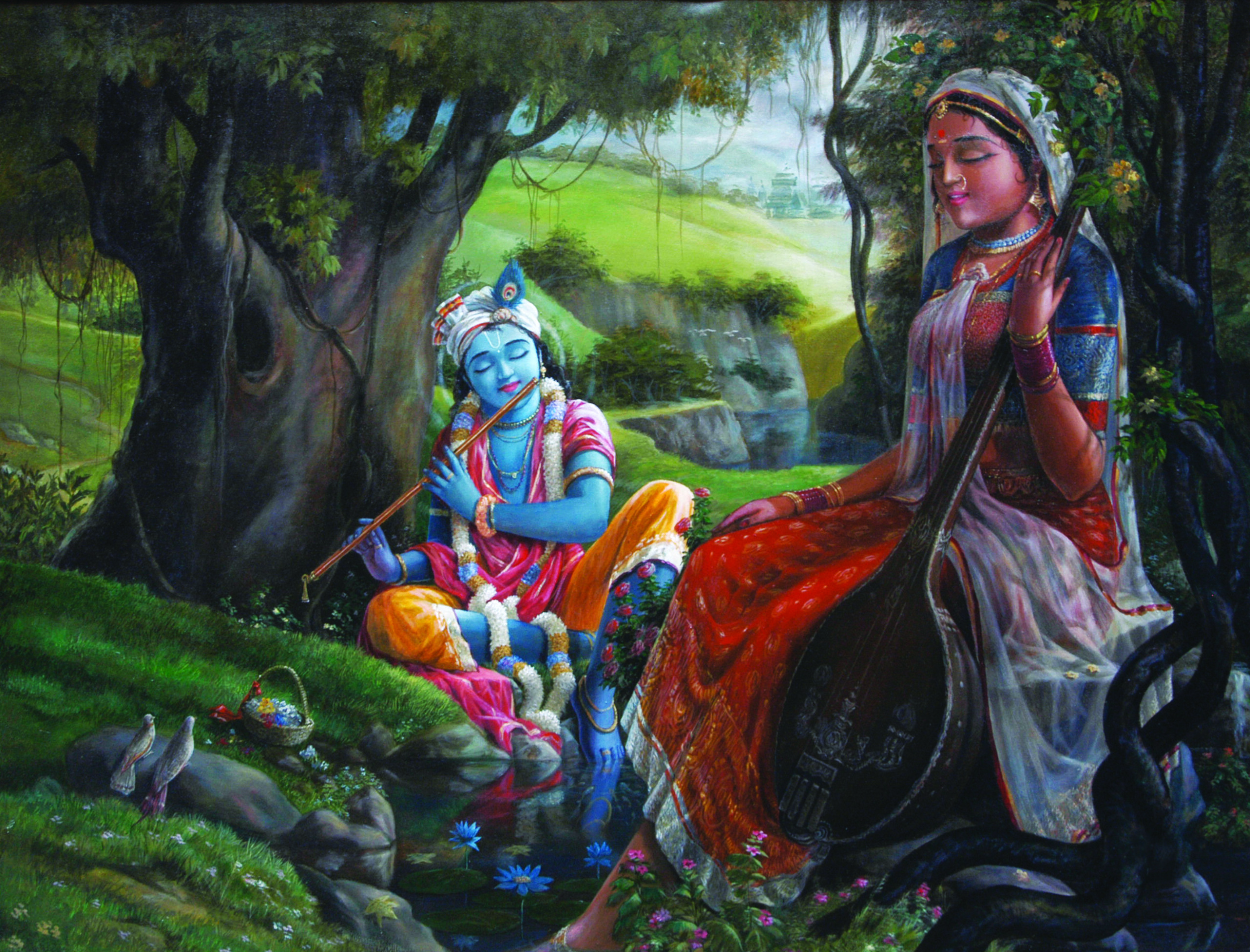
When a seed grows into a sapling, the seed loses its separate existence. When a flower becomes a fruit, the flower ceases to be. In the same way, love for God dissolves selfishness and unites us with Him. Such devotion is true bhakti. Bhakti assumes different names according to its nature. Hanumān’s devotion to Śrī Rāma was that of a servant to his master and is known as dāsya bhakti. Arjuna’s devotion to Śrī Kṛṣṇa was that of intimate friendship, called sakhya bhakti. Yaśōdā’s love for Śrī Kṛṣṇa was imbued with maternal affection and is known as vātsalya bhakti. The devotion of the individual soul (jīvātman) towards the supreme soul (paramātman) is called mādhurya bhakti — such was Rādhā’s love for Lord Kṛṣṇa.
The nectar of divine love is incomprehensible to the worldly mind. One who tastes it becomes one with God — one with Love itself. The devotee and God are not two, but expressions of the same divine consciousness (caitanya).
If we have not experienced true love, we may mistake worldly love for it. Yet there are clear distinctions between the two:
- Worldly love is selfish, whereas true love is selfless.
- Worldly love is centred on the body, whereas true love is rooted in pure consciousness.
- Worldly love often leads to sorrow, while true love abounds in peace and bliss.
- In worldly love, one becomes attached to the object of love; in true love, God becomes bound to the devotee.
- Worldly love soon loses its lustre, whereas the bliss of true love continues to grow.
- Worldly love is marked by duality and separation, whereas in true love, the devotee and the Beloved become one.
In true love, there is no sense of ‘I.’ Divine love arises from the heart — not from the mind or the intellect.
I am reminded of the story of Kaṇṇappa Nāyanār, an uneducated hunter whose love for Lord Śiva was pure and absolute, though he knew nothing of the formal protocols of worship. Once, he collected water in his mouth and used it to perform abhiṣēka (ceremonial bathing) for a Śivaliṅga. He even placed his foot upon the liṅga, having no sense that God was separate from himself. He had realized the truth of the great Upaniṣadic declaration, “You are That,” and thus merged into the Supreme.
In jñāna and karma yōgas, the responsibility lies with us to hold on to God — much like a baby monkey clings tightly to its mother as she leaps from branch to branch. In bhakti yōga, however, God holds firmly to the devotee, just as a mother cat carries her kitten. In this path of devotion, the devotee feels no burden.
We do not know when or how the Guru will shower her grace upon us. Before 2001, I had asked Amma four or five times whether I could join the āśram. Each time, she would respond, “Āśram life is difficult,” or simply, “Not now.” Once, I came to Amṛtapuri with only one change of clothes, assuming that Amma would not permit me to stay and that I would return after a day or two. When I went for darśan, I felt inspired to ask Amma once again if I could remain in the āśram. To my surprise, Amma agreed immediately. I was overjoyed, yet also hesitant, as I was then working for a company and running two businesses of my own. I wondered, “Should I stay now or return later? If I leave now, will I be allowed to come back?” In the end, I decided to stay. After six months, I sought Amma’s permission to settle my worldly affairs.
We should always follow the Guru’s instructions; otherwise, we may suffer unnecessarily. Let me share an experience to illustrate this truth. Many years ago, my sēvā was in the vehicle department of AIMS Hospital. I was asked to inspect the vehicles at the Amrita Vidyalayam in Pune. I was told clearly that Amma wanted brahmacāris to travel by train. However, on the day of departure, I learnt that an āśram truck was heading to Pune, and I chose to travel by truck instead.
We departed at 11 p.m. There were five of us in the cabin, including the driver. Two people could lie down to sleep. I chose to sit beside the driver and keep him company. By the time we reached Thrissur, I began to feel drowsy and drifted off. It was raining heavily. At around 2 a.m., the driver lost control of the vehicle, and the truck veered off the road and plunged headlong into a 20-foot ditch. The front portion of the truck, including the cabin, was submerged in water. Miraculously, none of us were injured, nor did we feel any fear. It was as though an invisible shield had completely protected us. Yet I also realized that had I followed Amma’s instruction and travelled by train, I could have avoided the accident.
We are where the mind is. Even being physically close to Amma will not benefit us if our thoughts are elsewhere. But when we are truly attuned to Amma, we lose all awareness of time. In true love, there is neither distance nor time.
The lives of the gōpīs (milkmaids) of Vṛndāvan beautifully exemplify this truth. Their devotion to Lord Kṛṣṇa flowed unceasingly, like a river. When the Lord played his flute, the gōpīs forgot themselves and became absorbed in the divine music. Their hearts overflowed with love for Kṛṣṇa, and fear vanished completely. Drawn irresistibly towards the source of that music, they ran to him. Some left their husbands, others their children, some their household duties, and others their adornments. Regardless of what they were doing, they abandoned it all to join their Beloved, moved solely by pure devotion.
To illustrate how any action can be spiritualized, Amma often refers to the example of the gōpīs. They renamed the dairy products they sold — milk, yogurt and ghee — as Kṛṣṇa, Mukunda and Murāri. Likewise, they renamed cooking ingredients such as pepper and coriander as Gōvinda and Mādhava. In this way, whatever they did, they remembered Lord Kṛṣṇa constantly.
When Kṛṣṇa finally left Vṛndāvan for Mathura, the gōpīs were overwhelmed with sorrow. They gathered together, sang his glories, and reminisced about the moments they had shared with him. Unable to bear the pain of separation, they wept aloud, their hearts steeped in longing for their Beloved.
Kṛṣṇa came to each of them, adorned in golden robes, wearing a floral garland, and bearing a gentle smile. With the inner eye, they beheld their Lord and, recalling his līlās (divine play), revelled in supreme bliss. The devout gōpīs received Kṛṣṇa within their minds and enthroned him upon the pedestal of their hearts. Thus, they found solace from the agony of separation. Free from ego, having enshrined the Lord within, the simple gōpīs — who knew nothing of formal meditation — attained a spiritual state even higher than that of accomplished yōgīs. Though Lord Kṛṣṇa was physically far away, distance posed no barrier to their communion with him. In every thought and every action, they beheld their Beloved.
When Uddhava arrived in Vṛndāvan carrying a message from Lord Kṛṣṇa for the gōpīs, he was astonished to discover that, through their pure love, the gōpīs had risen to a spiritual height surpassing even that of the great ṛṣis (seers). The one who had come to pass them a message instead sought their blessings.
Saint Tiruvaḷḷuvar declares:
The loveless belong to themselves alone;
The loving are others’, even to the bone. (Tirukkuraḷ, 72)
Those devoid of true love live as though everything belongs to them. Those endowed with true love consider even their bodies to belong to others and serve the world wholeheartedly.
Amma gives of herself — and of all that she has — for the welfare of the world. It is her pure love that inspires and sustains the vast selfless service activities she undertakes. Through this love, she helps us grow spiritually and cultivate a spirit of service. At times, Amma may point out our shortcomings. When received with acceptance, such correction does not cause pain but becomes a blessing.
There is a moving episode from the Rāmāyaṇa that illustrates divine compassion. Once, when Lord Rāma and Lakṣmaṇa went to bathe in the River Pampā, they left their bows and arrows on the riverbank. When Śrī Rāma returned after bathing and lifted his bow, he noticed blood on its tip. Tracing the blood, he found a frog lying unconscious. The Lord’s heart melted, and tears flowed from his eyes. Realizing that he had unknowingly injured the frog while placing his bow down, Lord Rāma gently lifted it, caressed it, and sprinkled water upon it. The frog soon regained consciousness.
The Lord said, “Because I did not notice you, I caused you great pain when I placed my bow down. Why did you not cry out? Had you done so, I would have removed it at once. You cry when a snake attacks you — why not now?”
The frog replied, “O Lord, it is true that I cry out even when pricked by a small stick. But you are God incarnate, and your sacred bow is used to destroy adharma and restore dharma. What merit I must have accumulated to be touched by your holy bow — beyond the reach of even Indra and the other gods! What does it matter if the body suffers or even perishes? My life has been sanctified by your divine touch.”
Saying this, the frog shed tears of devotion. Deeply moved by such bhakti, Lord Rāma caressed the frog and blessed it, saying, “You shall attain a realm of eternal bliss.”
Life is not free from trials and tribulations. Yet no matter how many problems or sorrows we face, love for Amma guides us and gives us the strength to surrender to her. Only through such surrender can we transcend life’s difficulties.
A few years ago, while I was serving at the Bengaluru campus of Amrita University, two brahmacāris went to perform pūjās in homes in the village of Bukkachandra near Hosur, Karnataka. In one house, they saw a photograph of Amma and so many Gaṇapati idols that there was hardly space to lie down. When asked whether they had met Amma, the family replied, “We are alive only because of Amma.”
The father explained, “I know only how to make Gaṇapati idols. I have no other skill. I had an unmarried daughter, no money, and many difficulties. When I heard that Amma was visiting Bengaluru in February, I went to see her. It was very crowded. Not knowing how to express my problems, I was advised to write a letter. I wrote one in Tamil and handed it to Amma during darśan. A month later, in March, a large car arrived near my house. A man got out and asked, ‘Who makes Gaṇapati idols?’ When I replied that it was me, he placed an order for 2,000 idols of various sizes and paid a substantial advance. With that money, I was able to accept a marriage proposal for my daughter and meet all the expenses.”Lord Kṛṣṇa blessed one Kucēla—but how many Kucēlas has Amma blessed! Amma’s life is a beautiful poem of true love, written not in words but in every action and gesture. If we allow Amma’s love to guide our thoughts, words and deeds, our lives too will become blessed. Let us strive to follow in her footsteps.